
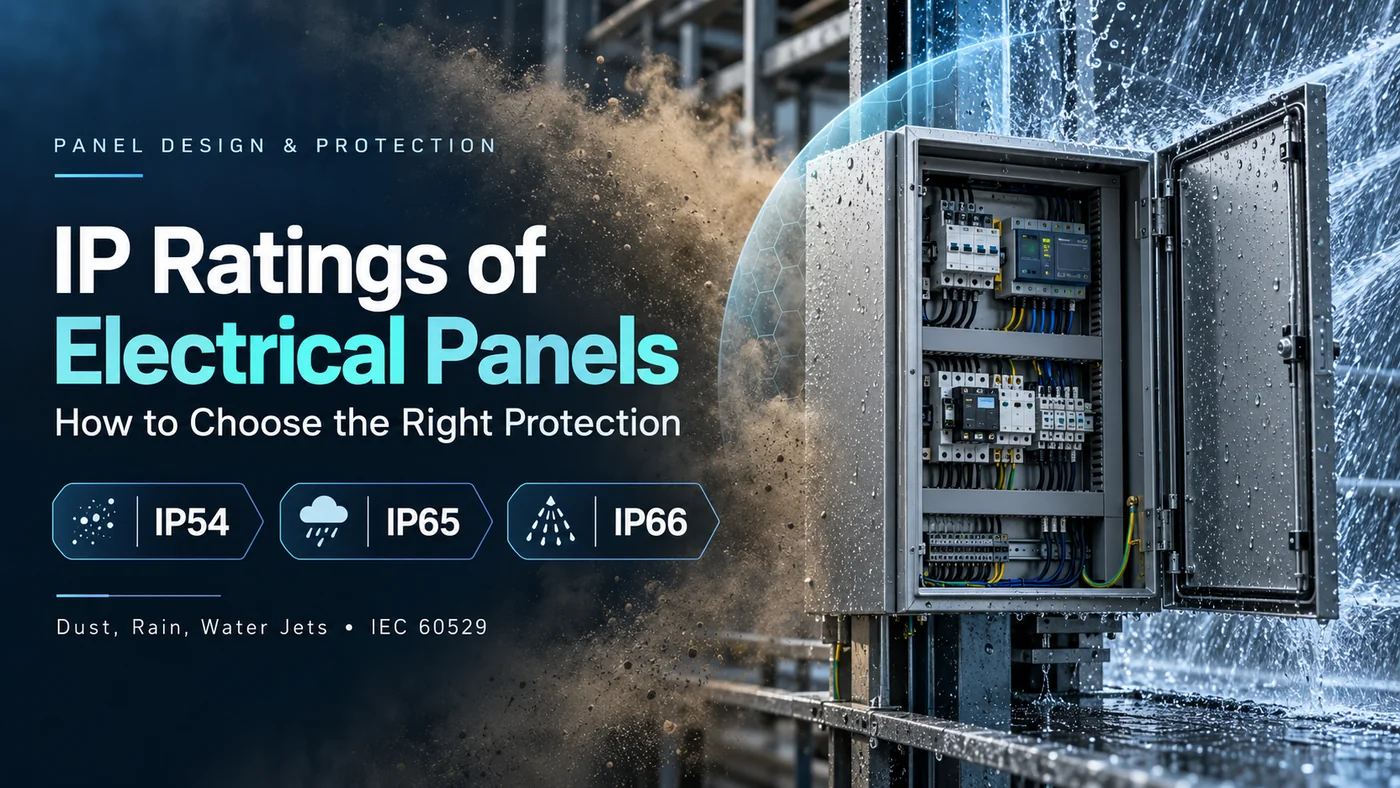
An electrical panel may look strong from the outside, but a small gap around a door, a poorly sealed cable entry or the wrong ventilation opening can expose valuable equipment to dust and moisture. That is where an IP rating becomes important.

What does an IP rating mean?
IP stands for Ingress Protection. Defined by IEC 60529, the code describes the degree of protection an enclosure provides against access to hazardous parts, solid objects and water. It helps engineers compare enclosures using defined test criteria rather than vague claims such as “dustproof” or “weatherproof.”
The two numbers tell different stories
First digit (0-6): protection against access to hazardous parts and the entry of solid objects, including dust. Second digit (0-9): protection against water under specified test conditions.
For example, IP65 means the enclosure is dust-tight (6) and protected against water jets (5). IP54 means dust ingress is limited so it does not interfere with satisfactory operation, while the enclosure resists splashing water.
Three ratings worth comparing
| RATING | SOLID PROTECTION | WATER PROTECTION |
|---|---|---|
| IP54 | Dust protected | Splashing water |
| IP65 | Dust-tight | Water jets |
| IP66 | Dust-tight | Powerful water jets |
The second digit describes a particular water exposure test. Immersion ratings (IPX7/IPX8) should not be assumed to include powerful water-jet protection unless separately verified.
REFERENCE & SELECTION
Common IP ratings at a glance
These are the ratings electrical panel designers and fabricators frequently encounter. The correct choice depends on exposure, installation instructions and the project specification.
| RATING | WHAT IT PROTECTS AGAINST | TYPICAL CONTEXT |
|---|---|---|
| IP20 | Finger protection; no water protection | Protected indoor equipment spaces |
| IP31 | Objects ≥ 2.5 mm; vertical dripping water | Dry indoor distribution areas |
| IP42 | Objects ≥ 1 mm; dripping water when tilted 15° | Indoor industrial locations |
| IP44 | Objects ≥ 1 mm; splashing water | Sheltered or mildly exposed areas |
| IP54 | Dust-protected; splashing water | Dusty workshops / industrial rooms |
| IP55 | Dust-protected; water jets | Exposed industrial or outdoor panels |
| IP65 | Dust-tight; water jets | Dusty or wet outdoor installations |
| IP66 | Dust-tight; powerful water jets | Demanding washdown / exposed sites |
| IP67 | Dust-tight; temporary immersion | Specific immersion-risk applications |
Suggested ratings by panel application
The following are starting points for specification-not universal minimum requirements. Always consider the environment, relevant assembly/product standard and thermal design.
| PANEL TYPE | ILLUSTRATIVE RANGE | DESIGN CONSIDERATION |
|---|---|---|
| MDB / SDB | IP31-IP54 | Indoor, condition-dependent |
| MCC / DOL / star-delta | IP42-IP55 | Workshop dust and moisture exposure |
| VFD / PLC control panel | IP42-IP65 | Ensure adequate heat management |
| ATS / changeover panel | IP42-IP55 | Location and access requirements |
| Power factor correction | IP31-IP54 | Ventilation is often critical |
| Outdoor feeder pillar | IP55-IP65 | Rain, dust and condensation |
| Solar DC combiner box | IP65-IP66 | Outdoor exposure, UV and heat |
Four questions before you select an enclosure
- Location - Is the panel in a clean electrical room, on a factory floor or exposed outdoors?
- Water exposure - Will it face condensation, rain, hose spray or flood risk?
- Cooling - Can the VFD, capacitor bank or transformer stay within its rated temperature?
- Installation - Will cable glands, instruments and vents preserve the required protection?
PRACTICAL MANUFACTURING TIPS
An IP rating belongs to the finished panel
A certified IP65 empty enclosure does not automatically make the completed electrical panel IP65. Drilling, cable glands, meters, push buttons, ventilation and door modifications can alter the protection level of the assembled product.
Six details that make the difference
- Door gaskets - Use continuous, correctly seated seals; confirm hinges and locks provide even compression.
- Cable entries - Select correctly rated glands and sealing arrangements for the actual cable size and entry position.
- Meter and switch cutouts - Check the installed component’s front-face sealing and the complete mounting arrangement.
- Ventilation - Filters, louvers and fans need suitable protection ratings; their openings may reduce the assembly rating.
- Outdoor conditions - Consider rain shields, condensation control, UV resistance, corrosion protection and drainage strategy.
- Final verification - Inspect the completed assembly and obtain appropriate design verification/test evidence for the claimed IP rating.
Avoid these four common misunderstandings
- “IP65 is waterproof.” No. It addresses dust ingress and water jets, not immersion.
- “Higher IP is always better.” Not if restricted airflow causes overheating inside a VFD or capacitor panel.
- “IP67 automatically includes IP66.” No. Immersion resistance and powerful water jets use different tests.
- “An IP65 enclosure means an IP65 panel.” Not after unverified cutouts, vents or cable entries are added.
A useful question before approving any panel
Where will this panel operate-and what will it actually face: clean indoor air, construction dust, wind-driven rain, water jets or temporary flooding? Start with that exposure, then choose and verify the enclosure system rather than selecting a rating by habit.
Standards and further reading
• IEC 60529 - Degrees of protection provided by enclosures (IP Code) - https://webstore.iec.ch/en/publication/2452
• IEC 61439-2 - Power switchgear and controlgear assemblies - https://webstore.iec.ch/en/publication/30043
• Intertek - Understanding and testing ingress protection - https://www.intertek.com/lighting/performance/ingress-protection/