

Introduction
Hello everyone, welcome back! In today’s vlog, we are going to explain how a star-delta motor starter works and, more importantly, calculate why it reduces starting current. We will use a 15-kilowatt, 415-volt, three-phase induction motor as our practical example. We will calculate the full-load current, direct-on-line starting current, star starting voltage, star starting current, and the effect on starting torque.
Quick Summary Table
| Item | Formula / Basis | Result |
|---|---|---|
| Motor power | Given | 15 kW |
| Line voltage | Given | 415 V |
| Power factor | Assumed | 0.85 |
| Efficiency | Assumed | 90% |
| Full-load current | I = P ÷ (√3 × V × PF × η) | ≈ 27.3 A |
| DOL starting current | 6 × 27.3 | ≈ 164 A |
| Star winding voltage | 415 ÷ 1.732 | ≈ 240 V |
| Star starting current | 164 ÷ 3 | ≈ 54.7 A |
| Current reduction | (1 − 1/3) × 100% | ≈ 66.7% |
| Star starting torque | (1/√3)² | ≈ 33.3% of DOL |
Our Motor Example
First, let’s take a 15-kilowatt motor operating from a 415-volt, 50-hertz three-phase supply. For this demonstration, we will assume a power factor of 0.85, efficiency of 90 percent, and a direct-on-line starting current of six times its full-load current. The motor must be rated to run in delta at 415 volts; check the nameplate before applying this method.
Full-Load Current Calculation
Let’s calculate the full-load current. For a three-phase motor, current equals output power in watts divided by root three, multiplied by line voltage, power factor, and efficiency. Here the power is 15,000 watts, the voltage is 415 volts, the power factor is 0.85, and efficiency is 0.90. When we substitute those numbers, the motor’s estimated full-load current is approximately 27.3 amps.
I = P ÷ (√3 × V × PF × η)
I = 15,000 ÷ (1.732 × 415 × 0.85 × 0.90)
I ≈ 27.3 A
Direct-On-Line Starting Current
Now, what happens if we start this motor directly in delta? We will assume it takes six times its normal full-load current at the instant of starting. So, we multiply 27.3 amps by six. That gives a starting current of approximately 164 amps. This is the current we want to reduce with a star-delta starter.
I DOL = 6 × I full-load
I DOL = 6 × 27.3 ≈ 164 A
Star Connection Winding Voltage
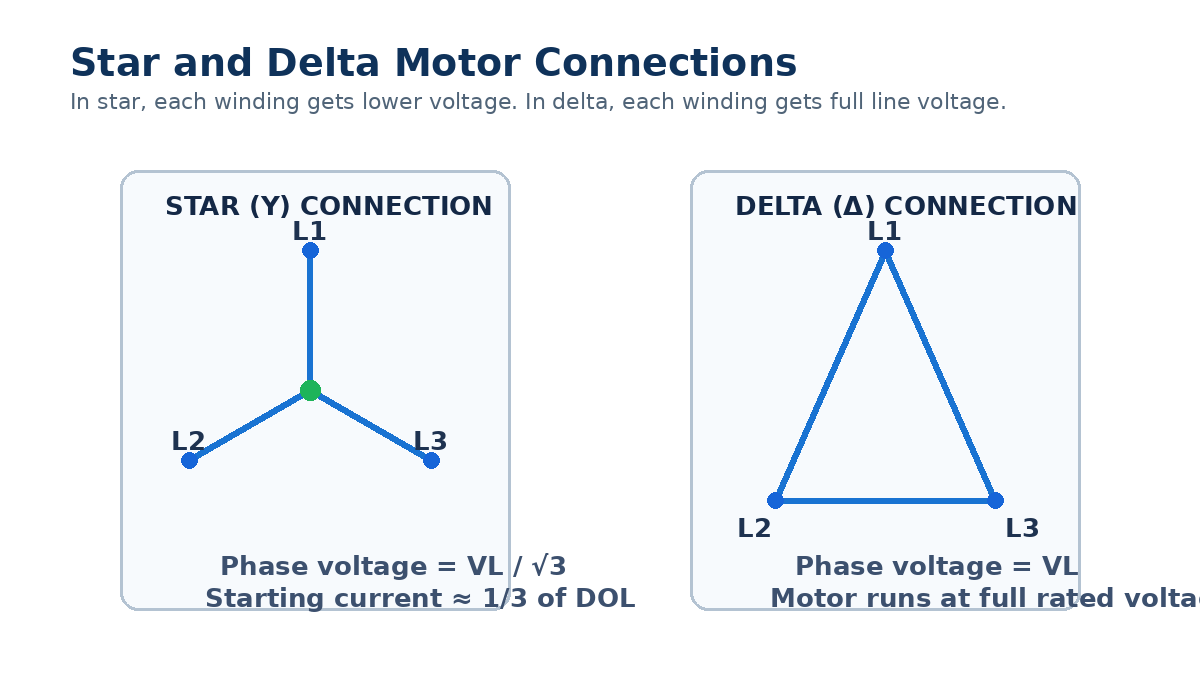
When the motor starts in star, each winding does not receive the full 415 volts. Instead, the winding voltage equals the line voltage divided by root three. So, 415 divided by 1.732 is about 240 volts. That is only 57.7 percent of the voltage each winding would receive in delta.
V winding (star) = V line ÷ √3
V winding (star) = 415 ÷ 1.732 ≈ 240 V
Star Starting Current
Here comes the important calculation. For the same motor at standstill and the same line supply, the star starting LINE current is approximately one-third of the direct-on-line delta starting LINE current. So, 164 amps divided by three equals approximately 54.7 amps. We have reduced the estimated initial line current from 164 amps to about 54.7 amps - a reduction of roughly 66.7 percent.
I star (line) = I DOL (line) ÷ 3
I star (line) ≈ 164 ÷ 3 ≈ 54.7 A
Current reduction = (1 − 1/3) × 100% = 66.7%
What Happens to Starting Torque?
But there is an important trade-off. Motor starting torque is approximately proportional to the square of the voltage applied to each winding. Because the star winding voltage is only one over root three of the delta winding voltage, star starting torque becomes approximately one-third of direct-on-line starting torque. That is why star-delta starting is suitable for applications that do not require high starting torque.
T star ÷ T DOL = (1/√3)² = 1/3
T star ≈ 33.3% of DOL starting torque
Star-to-Delta Changeover
When we press START, the main and star contactors close, and the motor accelerates in star. After the motor has accelerated sufficiently, the star contactor opens. Following a brief transition interval, the delta contactor closes, applying the full line voltage to each winding for normal running. The main and delta contactors are then energized. Remember: star and delta contactors must never close at the same time. A timer, mechanical interlock, and electrical interlock are essential. The transition may create a brief current spike, so the one-third rule refers to the initial starting comparison, not necessarily every moment of changeover.
Conclusion
Let’s recap our 15-kilowatt motor example. Full-load current is approximately 27.3 amps. Assumed direct-on-line starting current is about 164 amps. In star, each winding receives about 240 volts and the initial line starting current drops to approximately 54.7 amps. That is about a 66.7-percent reduction in initial line starting current - but also a reduction in starting torque to about one-third. That is how a star-delta starter works. Thanks for watching, and I’ll see you in the next electrical engineering vlog!
Presenter note: Calculated values are estimates based on stated assumptions. Use actual motor nameplate and manufacturer starting data for design and equipment selection.