
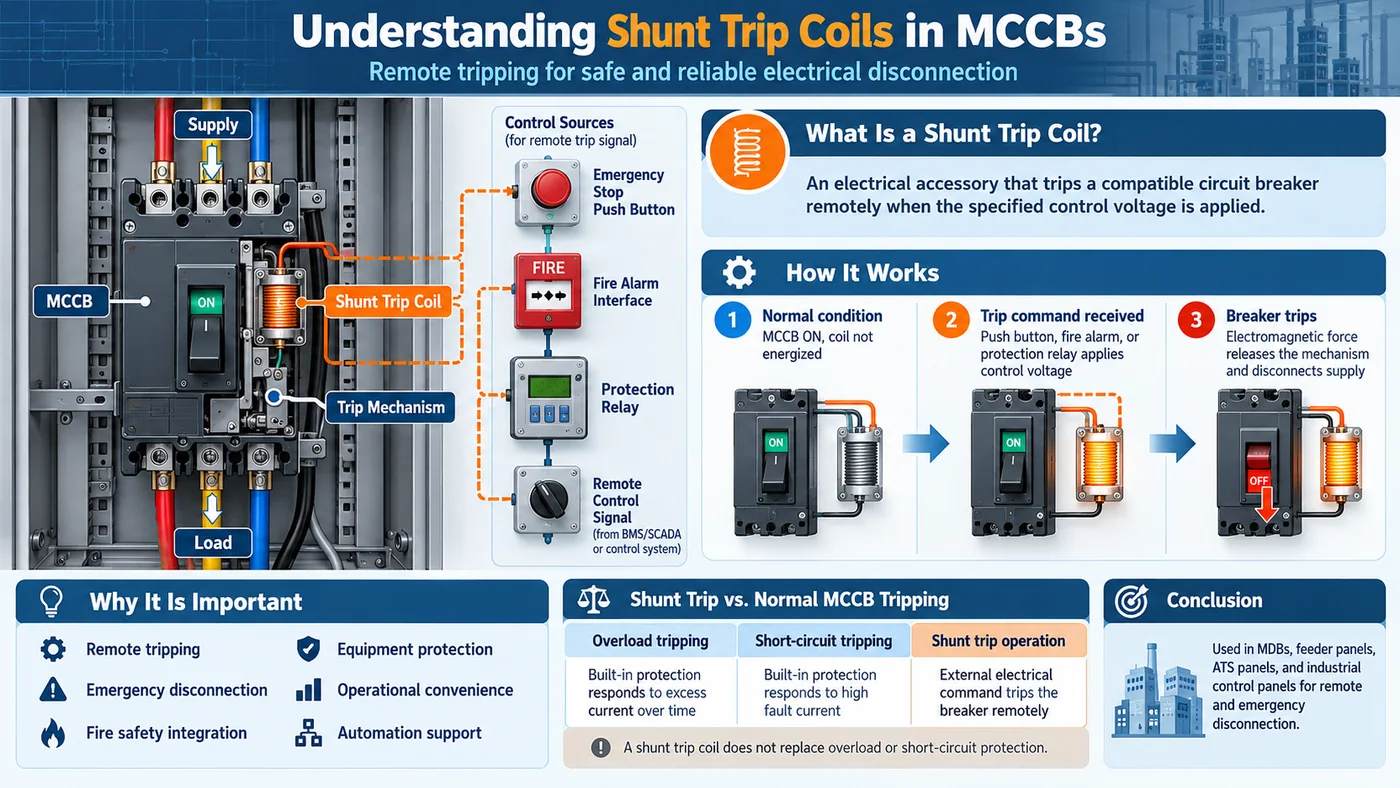
1. What Is a Shunt Trip Coil?
Modern electrical distribution systems require reliable protection and emergency disconnection facilities to ensure the safety of people, electrical equipment and installations. In industrial electrical panels, Molded Case Circuit Breakers (MCCBs) are widely used to protect electrical circuits against overloads and short circuits.
However, there are situations where a circuit breaker must be switched OFF remotely without physically operating its handle. For example, an operator may need to disconnect the main power supply during an emergency, or a fire alarm system may need to initiate electrical disconnection.
A shunt trip coil is an electrical accessory designed to trip a circuit breaker remotely when an appropriate control voltage is applied to its coil.
Shunt trip coils are commonly used in Main Distribution Boards (MDBs), feeder panels, Automatic Transfer Switch (ATS) panels and industrial control panels where remote disconnection is required.
Understanding its operating principle, rated voltage, control circuit and installation requirements is important for designing safe and reliable electrical panel systems.
2. Operating mechanism?
A shunt trip coil is an electromagnetic tripping mechanism installed inside or attached to a compatible circuit breaker.
When the specified voltage is applied to the coil, an electromagnetic force is produced. This force operates a mechanical tripping mechanism, causing the circuit breaker contacts to open and disconnect the electrical supply.
Unlike the normal overload and short-circuit protection mechanisms, which respond to electrical faults in the protected circuit, a shunt trip coil operates in response to an external electrical command.
The command may come from a push button, emergency stop circuit, fire alarm system, protection relay or other suitable control device.
3. How Does a Shunt Trip Coil Work?
The operation of a shunt trip coil can be explained in three main stages.
Stage 1 - Normal operating condition
Under normal operating conditions, the MCCB remains in the ON position, and the shunt trip coil is not energized.
The circuit breaker continues to supply power to the connected load, provided that no other tripping condition occurs.
Stage 2 - Trip command is received
When an external trip command is generated, the control circuit supplies the specified voltage to the shunt trip coil.
For example, the coil may receive a command from an emergency push button, fire alarm interface or protection relay.
The applied voltage produces a magnetic field that operates the internal tripping mechanism.
Stage 3 - MCCB trips and disconnects the supply
The tripping mechanism releases the circuit breaker's operating mechanism, causing its contacts to open.
As a result, the electrical supply to the protected circuit is disconnected.
After the trip operation, the MCCB generally needs to be reset and switched ON again manually or through an approved operating mechanism, depending on the breaker design.
The cause of the trip should be investigated before the circuit is returned to service.
Note: The exact operating sequence and reset procedure depend on the MCCB manufacturer's design.
4. Why Is a Shunt Trip Coil Important in Electrical Panels?
Shunt trip coils provide an effective method of remotely disconnecting electrical supplies. They are particularly useful in installations where quick disconnection is required for safety or operational reasons.
Their main advantages include:
- Remote tripping: Allows an MCCB to be tripped without physically accessing the breaker.
- Emergency disconnection: Enables an external emergency circuit to initiate disconnection.
- Fire safety integration: Can be interfaced with an appropriate fire alarm or suppression system when the installation design requires it.
- Equipment protection: Allows suitable protection relays or control systems to disconnect a circuit when a defined condition occurs.
- Operational convenience: Makes it easier to control breakers installed inside large or difficult-to-access electrical panels.
- Automation: Supports integration with industrial control and building management systems.
However, the effectiveness of these functions depends on the correct control circuit design, reliable control power and compatibility between the coil and the MCCB.
5. Shunt Trip Coil vs. Normal MCCB Tripping
An MCCB can trip through its built-in protection mechanisms or through an external shunt trip accessory.
Understanding the difference is important when designing an electrical protection system.
Overload Tripping
Overload protection operates when the current exceeds the permitted level for the specified time.
Depending on the MCCB design, this function may be provided by a thermal or electronic trip unit.
Short-Circuit Tripping
Short-circuit protection operates when the current reaches the relevant fault threshold.
The breaker opens to interrupt the fault current within its rated breaking capability and operating characteristics.
Shunt Trip Operation
A shunt trip coil operates when the specified external electrical command is applied.
It does not independently measure whether an overload or short circuit exists.
A protection relay may initiate a shunt trip command when a monitored fault condition occurs, but the relay and control circuit must be designed appropriately.
Important: A shunt trip coil should not be considered a replacement for the MCCB's normal overcurrent protection.
6. Conclusion
Shunt trip coils are important accessories used with MCCBs to provide remote electrical tripping when an external control command is received. They are widely applicable in distribution boards, feeder panels, industrial control panels and installations requiring remote or emergency disconnection.
Their operation is based on an electromagnetic mechanism that releases the circuit breaker's tripping mechanism when the specified control voltage is applied.
For reliable performance, engineers must select a compatible accessory, verify the control voltage, design the control wiring correctly and ensure that the coil is operated within its specified limits. Proper installation, testing and maintenance are also essential.
A shunt trip coil does not replace the normal overload and short-circuit protection of an MCCB. Instead, it adds a useful remote-tripping function to the overall electrical protection system.