Introduction
Electrical enclosures and switchboards are used in factories, commercial buildings, public areas and outdoor installations. In these locations, doors and panels may be exposed to accidental knocks from tools, equipment, vehicles or everyday site activity.
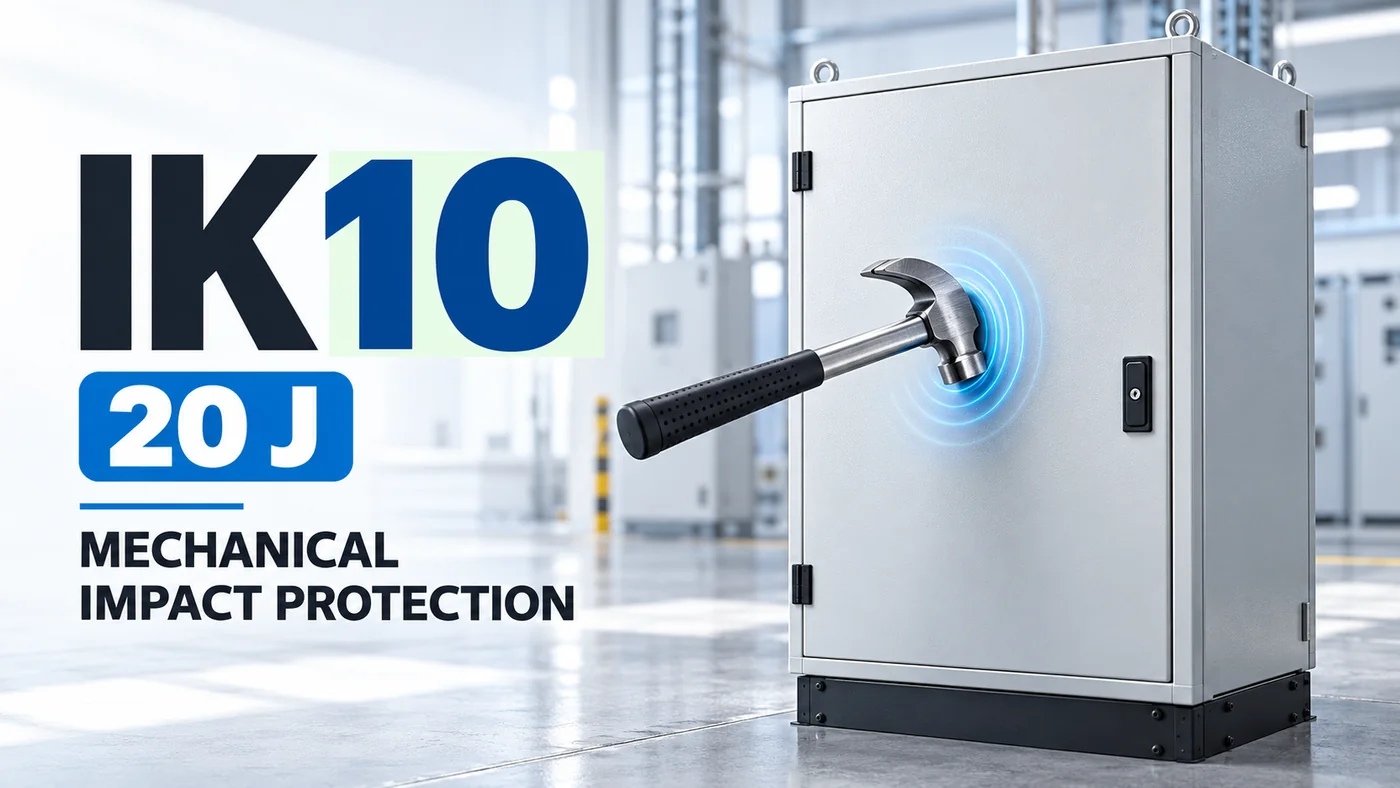
An IK rating indicates the degree of protection an enclosure provides against external mechanical impacts under a specified test. Understanding the rating helps project teams choose equipment suited to its installation environment.
For Meklet Metal Technology projects, the required impact protection should be considered alongside the enclosure’s materials, construction, mounting arrangement and other environmental requirements.
What does an IK rating mean?
The IK code is defined by IEC 62262, which classifies the protection provided by enclosures against external mechanical impacts.
The impact test is not defined by IEC 61439 Part 10. The IEC 61439 series covers requirements for low-voltage switchgear and control gear assemblies; IEC 62262 is the standard that defines the IK classification. IEC 60068-2-75 provides standardized hammer-test methods used to apply specified impact energies.
An IK rating describes resistance to a defined impact test. It does not guarantee that an enclosure will remain undamaged or operational after every real-world impact.
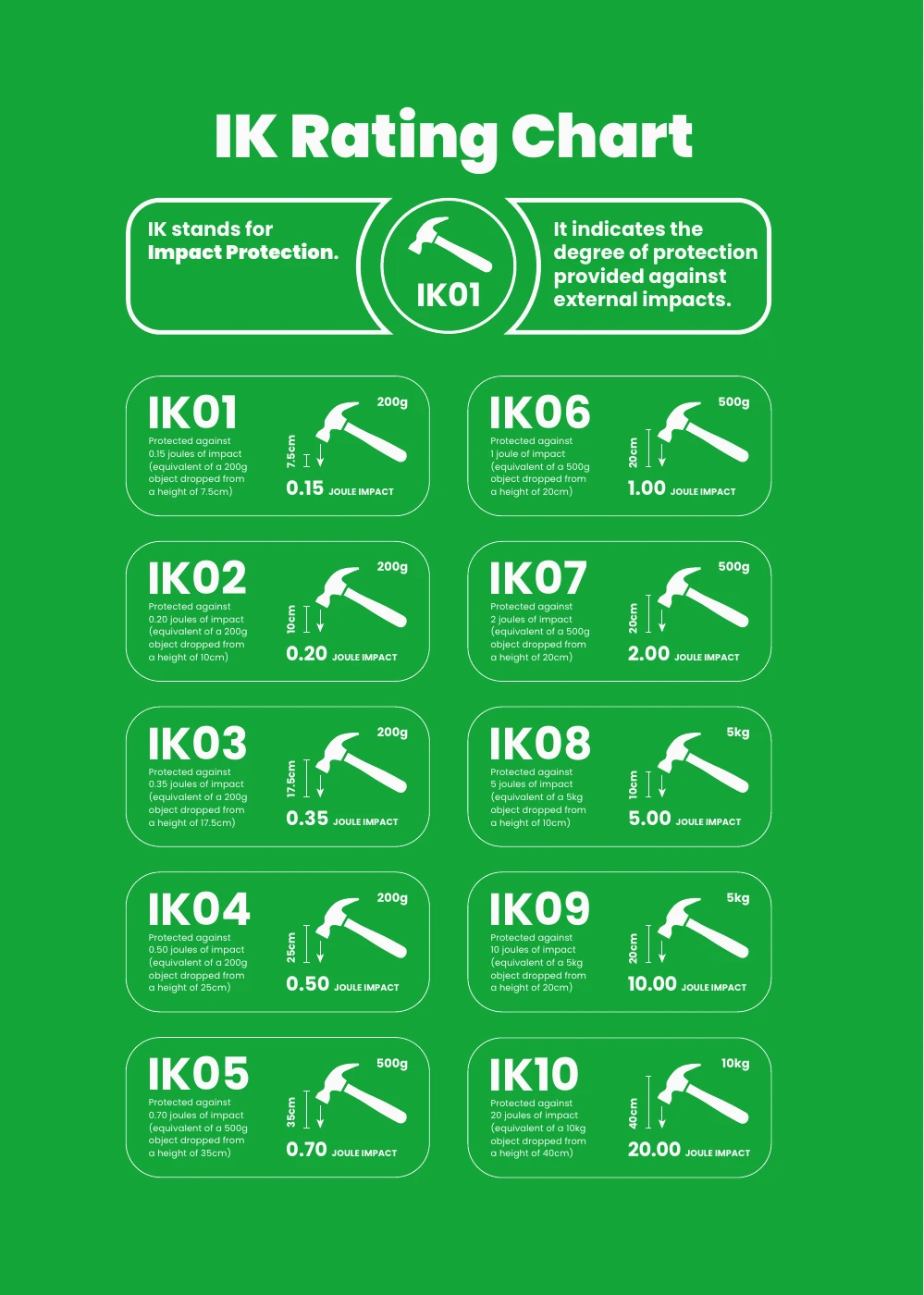
IK rating and impact energy
Each IK code corresponds to a specified impact energy, measured in joules. The classification includes IK01 to IK10, and the 2021 amendment to IEC 62262 added IK11 at 50 joules.
| IK code | Impact energy |
|---|---|
| IK00 | No protection classified |
| IK01 | 0.14 J |
| IK02 | 0.20 J |
| IK03 | 0.35 J |
| IK04 | 0.50 J |
| IK05 | 0.70 J |
| IK06 | 1 J |
| IK07 | 2 J |
| IK08 | 5 J |
| IK09 | 10 J |
| IK10 | 20 J |
| IK11 | 50 J |
The joule value represents the specified test severity. It should not be treated as a guarantee against every object, impact angle, contact shape or installation condition.
How is an enclosure tested?
The test setup depends on the applicable requirements and the enclosure configuration being assessed. In general, the process includes:
- Define the requirement. Identify the IK rating, applicable product requirements and the enclosure configuration to be assessed.
- Prepare the test sample. Assemble and mount the enclosure as required for the test, including the relevant doors, covers and hardware.
- Apply the impacts. Use the specified test apparatus, impact energy, number of strikes and locations. IEC 60068-2-75 describes three coordinated hammer-test methods.
- Assess and record the results. Inspect the enclosure against the applicable acceptance requirements and document the test conditions and findings.
The tested sample and configuration matter. A report should make clear which enclosure, mounting arrangement and components were covered by the test.
Why IK protection matters
A suitable IK rating can help reduce the risk of mechanical damage to an enclosure in its intended environment. It also gives specifiers and buyers a common way to describe the impact-protection requirement.
However, IK protection is only one part of an enclosure specification. It does not, by itself, establish protection against dust or water ingress. Those requirements are addressed separately through the IP code under IEC 60529.
An IK rating also does not replace the design and verification requirements that apply to a complete switchboard assembly under the relevant IEC 61439 standard.
How to choose an IK rating
When specifying an enclosure, consider:
- Whether the enclosure is in a public, industrial, commercial or restricted-access area.
- The likelihood of accidental contact from people, tools, moving equipment or vehicles.
- The enclosure’s mounting position and the exposure of doors, covers and other accessible surfaces.
- Whether the tested configuration matches the enclosure and accessories required for the project.
- The separate requirements for IP protection, corrosion resistance and other site conditions.
Where an IK rating is required, ask for supporting test documentation that identifies the standard, rating, tested configuration and results. This makes it easier to confirm that the evidence matches the product and installation being specified.
Conclusion
IK ratings help describe an enclosure’s resistance to standardized mechanical impacts. IEC 62262 defines the IK classification, while IEC 60068-2-75 describes coordinated hammer-test methods. Together, these standards help project teams specify and assess mechanical impact protection for electrical enclosures.
For switchboards and electrical enclosure projects, consider IK requirements alongside the relevant assembly standard, IP rating and conditions at the installation site. Contact Meklet Metal Technology to discuss the enclosure requirements and supporting documentation for your project.